
Menu
· Elizabeth De Young
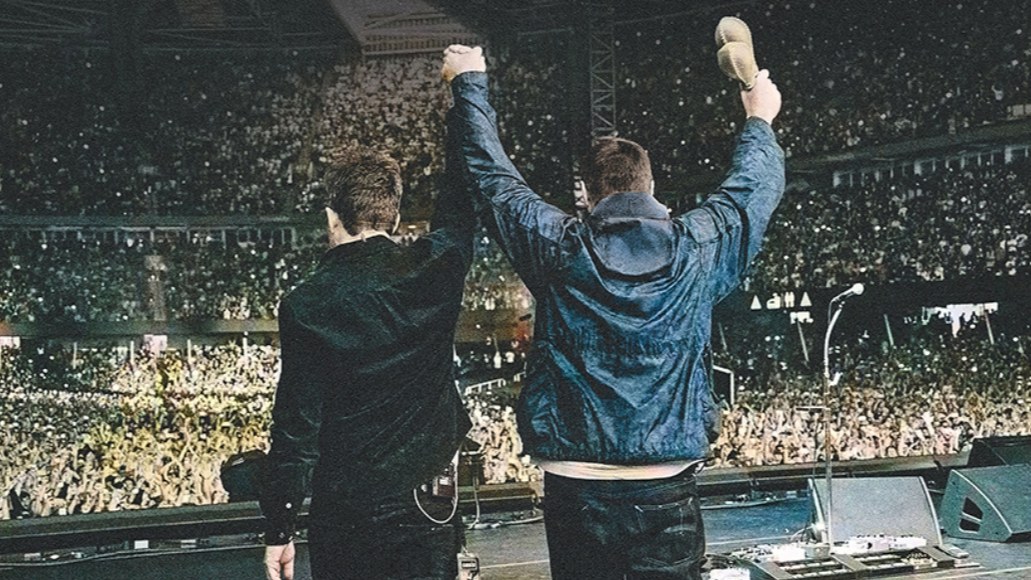
“Nostalgia seems to be a bad word these days,” Liam Gallagher remarks towards the close of the documentary, but acknowledges the importance of looking to the past for a better future. After 15 years of silence between the Gallagher brothers, Liam and Noel, “Oasis: Don’t Look Back in Anger” offers audiences and the band a reconciliation.
Directed by Dylan Southern and Will Lovelace, a duo who have collaborated on films for LCD Soundsystem and Blur, “Don’t Look Back in Anger” doesn’t try to tell a 30-year tale - but instead shows how to rewrite the narrative.
While the film takes viewers through a brief history of Oasis from their origins in Manchester circa 1991, it focuses on the present story rather than rehashing the past. The mentality of living in the present moment is one that drives the documentary; from fans across the globe to the brothers' own absolution, the footage captures a jubilation that could only originate from those who have been down and got back up.
As one fan articulated in the documentary: when you fall, most people and music will try to immediately pick you up, but Oasis falls down with you. Together you’re able to build your way back to the top, and appreciate viewing how far you’ve come.
Care to Comeback
Oasis made headlines in 2025 when Liam and Noel announced their reunion; however, many doubted the rekindling would last. The documentary drops the viewer immediately into rehearsals, allowing no buffer between their 2009 breakup and the present day. Understanding the tension, Southern and Lovelace utilize creative and compelling shot angles that are intended to keep cameras out of sight and mind of the band.
The director duo doesn’t linger on the rehearsal space for long, only enough time to set the tone - one of dedication and hard work. Although Liam bursts in and out of rehearsal like a fed-up high schooler waiting for the bell, there’s an undeniable stage chemistry that cannot be bottled up between the brothers.
“It takes a lot of caring to not give a fuck,” Liam Gallagher ends a rant about his past and present ‘arrogant’ behavior. What does caring look like to a musician? Is it something visual in their performance or an intangible aspect that can only be felt through the music?
While the brothers may have had their disagreements in the past, one assurance is how seriously they take the music. By the time Oasis is ready to hit the stage, it’s like they never left.
For the Fans, From the Fans
Both the band and filmmakers seem singled in on one idea; this is not only a triumphant revival for the Gallaghers and Oasis, but also for the fans that championed them through every season of life. From voice-overs to footage, the documentary is almost an even split of fans and band content.
Amongst every sea of fans packed into each stadium, Southern and Lovelace select a choice few with stories that resonate above any song. As audiences step into an Oasis fan’s life for a few moments, it reveals that we not only care for the music, but also how the music becomes inseparable from how we care about one another.
Noel’s lyrics that defined a generation are now being redefined by Gen Z listeners; it’s not just a time or a place that makes art significant but those who give it new life by living it. The tour takes Oasis through every major continent, connecting with listeners who may know the lyrics, but feel the meaning somewhere deeper.
At each show, Liam takes control of the crowd and commands everyone to “turn around,” which Noel reveals was never a band decision, but an important part of the show nonetheless. The concert becomes less of a spectacle and more a congregation as attendees throw their arms around another and jump up and down - a sonic unity personified.
Devout Concertgoers
Watching Oasis’s experience being welcomed back to each country by a wall of sound inspires hope on many fronts; maybe there’s a chance to forgive and forget for a better future, but there’s also an opportunity to remember what concerts were like in the 90s and early 2000s.
After cellphones and Covid-19, concerts felt changed forever - an in-person experience awaiting an online post to give it purpose. What Southern and Lovelace capture amongst the crowds is something reminiscent of a Grateful Dead Shakedown Street. Matching attire, singing in the streets and hardly any cellphones obstructing the stage, Oasis have somehow reminded us of our humanity amongst technology.
Tear-stained faces and awe-struck smiles, viewers of the documentary can empathize with every audience member. Music helps us to imagine different experiences and take on new perspectives, but once shared, it helps us to understand one another.
Listening to music or attending a concert is a reciprocal process that occurs between every concertgoer and member on stage. Each individual takes something unique with them, and adds their own personal touches as well.
As Oasis honored Gary Mounfield, aka Mani, Liam Gallagher also calls to mind how this process is even more prevalent and personal in the music industry. After attending The Stone Roses’ concert in his youth, Gallagher decided to pursue a career in music, continuing a cycle of inspiration through Oasis.
The documentary points at how there are certain parallels between religion and music; a higher being that can speak to your deepest thoughts and feelings, unite you with others and most importantly, teach you to forgive.
Don’t Look Back
Overall, Southern and Lovelace produce a worthwhile experience that viewers leave feeling lighter and enlightened. It’s less about the band and more about the connection their music created. If you couldn’t get tickets for their comeback tour, the documentary depicts all of the heart-pounding moments and hit songs for a much smaller price.
Don’t mistake this documentary for the Gallaghers' victory lap, as Oasis seems to just be getting back into the swing of things by the end of the film.